|
For the third consecutive day, the ongoing floods in Houran valley, western Iraq, are being monitored
2026-05-01
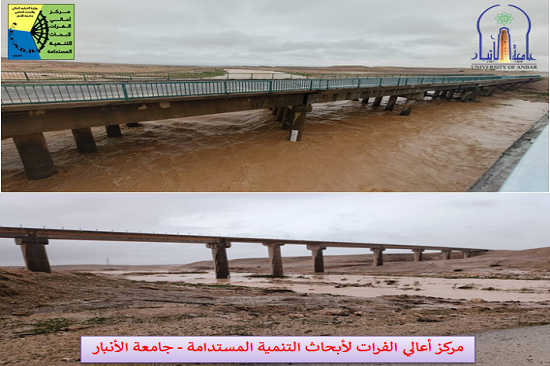
The technical staff at the Haditha terminal station, affiliated with the Upper Euphrates Center for Sustainable Development Research at University of Anbar, are continuing their fieldwork to monitor the ongoing floods in Houran valley, western Iraq, for the third consecutive day, as part of the center's efforts to monitor and analyze hydrological phenomena.
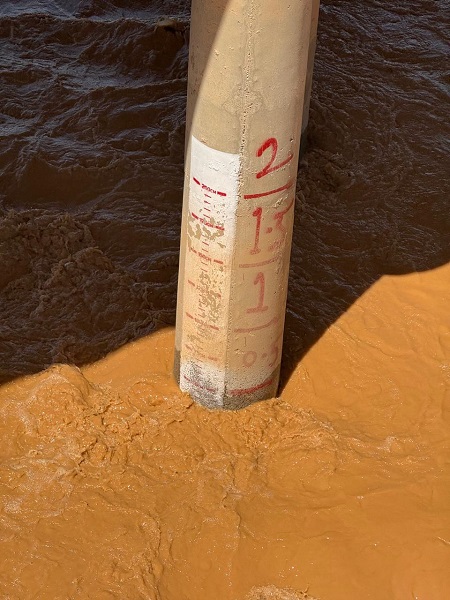
Engineer Juma’a Mohammed Ahmed, the station manager, stated that the monitoring teams recorded the continued flow of floodwaters in Houran valley. The discharge reached approximately 15 m3 per second at 4:00 PM on Wednesday, April 29, 2026, at the Houran Bridge on the road connecting Ramadi and Haditha, after the area experienced a peak flow exceeding 200 cubic meters per second. He added that on Thursday morning, April 30, 2026, a discharge of 10 m³/s was recorded at 10:45 AM, confirming that monitoring would continue until the end of this weather system.
For his part, Assistant Professor Dr. Atheer Saleem Obaid, Head of the Planning and Databases Department at the Center, explained that the Center's monitoring stations recorded rainfall amounts for April 28 and 29, 2026, as follows: 1.8 mm at the Center's station within the University of Anbar campus, 4.6 mm at the Haditha terminal station, and 3.8 mm at the Rutba station.
Professor Dr. Ammar Hatem Kamel, Director of the Center, pointed out that despite the relatively low recorded rainfall amounts, it led to the formation of flash floods in Houran valley. This was due to the soil becoming saturated with water from the heavy rains that occurred last March, resulting in a significant decrease in infiltration rates and an increase in the surface runoff coefficient, with more than 90% of the rainwater being converted into surface runoff.
He explained that the significant increase in floodwaters followed by a rapid decrease indicates that the center of the rainstorm was close to the measuring station at the Houran Bridge. This contributed to a substantial increase in water flow to the Euphrates River, which will be estimated and analyzed later.
The center's director added that this data and field observations are of great importance in supporting hydrological modeling studies and developing water resource management models for the region, in line with Anbar University's goals for achieving sustainable development and Vision 2030.
To watch videos of the Houran Valley floods on Thursday, April 30, 2026.
#university_of_anbar
#Upper_Euphrates_Center_for_Sustainable_Development_Research
#SDG13
|