|
Protecting Buildings and Foundations from Earthquake Risks
2026-04-20

Dr. Salem Mahmoud Ahmed
Upper Euphrates Center for Sustainable Development Research – University of Anbar
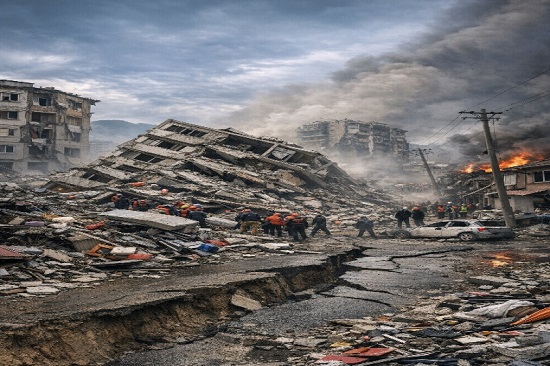
Earthquakes are among the most dangerous natural disasters threatening engineering, vital, and other infrastructure, archaeological, and public buildings. They result in significant human and material losses due to the sudden dynamic impacts they generate. Therefore, it has become essential to protect these buildings more safely. Earthquake-resistant designs are recommended, especially in areas prone to such disasters. Effective protection depends on understanding the behaviour of both the soil and the structure, integrating geotechnical and structural solutions. Earthquakes result from the sudden release of energy stored in the Earth's crust, generating seismic waves that travel through the soil and affect structures. These waves cause horizontal, vertical, and compressive vibrations in building foundations, leading to additional shear forces and moments that may exceed the structure's design load-bearing capacity, resulting in significant damage that can even lead to total collapse. Therefore, the study of earthquake engineering has become an essential discipline to ensure the safety of structures.
- The Impact of Earthquakes on Soil and Foundations:
- Differential Settlement: This results from the rearrangement of soil particles under the influence of seismic forces, leading to cracks in the foundations.
- Liquefaction: In saturated sandy soils, the soil loses its strength and behaves like a liquid, threatening the building with collapse.
- Landslides: In sloping areas, earthquakes can cause landslides that lead to the destruction of structures.
- Soil Improvement
There are methods for protecting the soil, which are essential preventative measures before project implementation, aimed at increasing its ability to withstand seismic forces.
- Compaction: Increasing soil density and reducing voids to minimize settlement and liquefaction.
- Grouting: Introducing bonding materials such as cement or polymers to increase soil cohesion and reduce water permeability.
- Stone/Sand Columns: Improving rigidity and resistance to differential settlement.
- Chemical treatment (soil stabilization) involves adding bonding or nanomaterials to improve the mechanical properties of the soil.
- Types of Earthquake-Resistant Foundations
The choice of foundation type depends on the soil type and load intensity. The most important options include:
- Shallow Foundations: Used for strong soils and hard layers close to the surface.
- Raft Foundations: Distribute loads over a wide area to reduce differential settlement; useful for heavy buildings.
- Piles: Transfer loads to deeper, more stable and rigid layers; used when the surface soil is weak or there is a high water table. Deep foundations are considered the safest option in seismic zones prone to liquefaction or partial soil collapse.
The structural design must take into account the forces resulting from earthquakes. Among the most important systems are:
-
-
- Base Isolation: Placing flexible layers between the foundation and the structure reduces the transmission of vibrations to the building.
- Damping systems, such as hydraulic, mechanical, or rubber shock absorbers, absorb a portion of seismic energy and reduce displacement and vibrations.
- Shear walls increase the building's rigidity and distribute horizontal forces.
- Moment-resisting frames withstand moments and bending caused by earthquakes while providing sufficient flexibility to prevent brittleness.
- Use of modern materials: high-resilience reinforced concrete, deformation-resistant steel, and nanomaterials to improve impact resistance.
- Excavation of trenches with specific designs around the external foundations of buildings and filling them with shock-absorbing rubber materials.
Design according to codes and standards: International standards must be adhered to, such as:
-
- Eurocode 8
- IBC (International Building Code)
- UBC (Uniform Building Code)
- Iraqi Earthquake Code
- Preventive Measures Before Construction
- Conduct comprehensive soil tests (SPT, CPT, and Plate Load Test).
- Avoid building on fill or unstable slopes.
- Lower the groundwater level in saturated areas.
In Iraq, the northern regions and large parts of the central region have sandy loam soils, which are most susceptible to wave amplification. Therefore, deep foundations with seismic isolation are recommended for vital buildings. In the southern regions, where the soils are weak and waterlogged, soil improvement through grouting or sand or stone piles is preferred to ensure building stability before construction. In the western regions, the soil is strong but gypsum-bearing, so the use of amendments such as cement, oxides, chemical solutions, and other materials is recommended. In conclusion, protecting foundations from earthquakes requires an integrated approach that combines soil analysis, appropriate foundation selection, and resistant structural design. Therefore, focusing on soil improvement and using strong foundations and advanced damping systems significantly reduces damage. Adherence to engineering codes and international standards ensures the highest levels of safety for structures in seismic zones.
#university_of_anbar
#Upper_Euphrates_Center_for_Sustainable_Development_Research
#SDG9
#SDG11
|