| News Details |
(Very important: for researchers in the field of climate change) Flood and rain statistics for March 2024
2024-04-06

As part of its program to monitor climate change and in line with the university's strategic plan to achieve Vision 2030, for the sustainable development goals, the Upper Euphrates Basin Developing Centre announced statistics on the monitoring of runoff events and rains for the month of March 2023.
The Planning and Databases Department at the centre explained that the amount of rain recorded in the city of Ramadi during the month of March amounted to 36.8 mm, compared to 48.1 mm recorded in the same period, i.e. March 1989, and 34.3 mm recorded in March 1995.
As for the Rutba station, in March 2024 a rainfall amount of 58.8 mm was recorded, compared to 89.2 mm recorded in March 1972 and 59.2 mm recorded in March 1974. In the city of Haditha, rainfall was recorded in March 2024 amounting to 25.4 mm compared to 92.8 mm recorded in March 1974, 70 mm recorded in March 2002, 65 mm recorded in March 1991, and 61.6 mm recorded in March 1996.
The city of Ramadi recorded 7 rainy days during March 2024, compared to 6 rainy days in Rutba and seven rainy days in Haditha city.
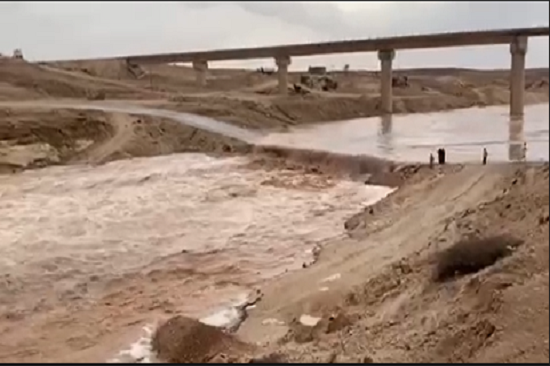
As for flood revenues, the Upper Euphrates Basin Developing Centre station - University of Anbar in Horan valley near the Ramadi-Haditha road recorded inputs to the Euphrates River amounting to 37,494,000 cubic meters as a result of the floods that began on 25-3-2024, noting that the measurement site comes after several dams in the upper valley, namely the Rutba, Horan 2, Horan 3, and Masad dams, which indicates the large inputs of this valley, while Horan valley inside the city of Rutba at the centre’s measurement station on the Horan Bridge in the city recorded inputs of 5,976,000 cubic meters, which are inputs that come from the valley floods after the Rutba Dam.
The inputs of Al-Massad valley, which meets Horan valley after the city of Rutba, amounted to 1,976,400 cubic meters, compared to 1,922,400 cubic meters, the inputs of the floods of Zagdan valley, and 1,288,800 cubic meters of inputs of Hajlan valley.
This data is extremely important for climate change researchers and postgraduate students in the field of water resources and hydrology.
#university_of_anbar
#Upper_Euphrates_Basin_Developing_Center