
| News Details |
The Impact of Climate Change on Population Migration in Al-Rutba District
2026-05-14

Assistant Instructor Mohammed Raheem Mohammed
Upper Euphrates Center for Sustainable Development Research – University of Anbar
This study aims to demonstrate the impact that climate change can have on population movements in arid and semi-arid regions in general, particularly in western Iraq and Al-Rutba District. Al-Rutba District is one of the most important districts in western Anbar Governorate and Iraq, and as such, it is an environmentally fragile desert region. Therefore, it is among the areas most affected by climate change in Iraq.
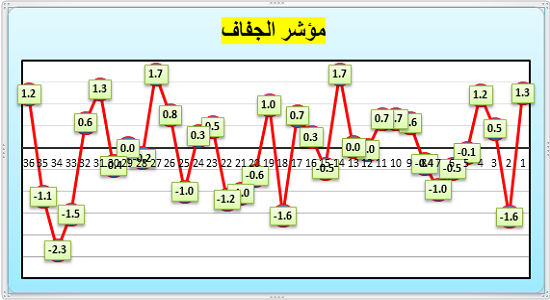
This has been reflected in population migration in recent years due to a rise in maximum temperatures over the past 36 years to 1.63°C, while in August the change reached 3.57°C, as shown in Table 1. This change increases the water demands already faced by the study area due to evaporation. The decline in rainfall amounts, as shown in Table (2) to (19.26 mm), led to an increase in drought indicators, as in Figure (1).
This resulted in the deterioration of natural resources, especially water resources, as groundwater levels decreased significantly between fixed and mobile water. The water decline was reflected in the deterioration of water quality and also the weakness of irrigation operations for agricultural crops as a result of the drought that prevailed for three consecutive seasons (2020, 2021, and 2022).
Natural pastures caused famines for livestock, which incurred significant losses, between death due to epidemics and a decrease in their prices due to the costs of spending on them. This negatively affected the livelihoods of the population, especially farmers and herders, in search of better living opportunities and basic services in cities, which are the most active in providing diverse job opportunities or migration to rural areas in the districts of Anbar Governorate in order to preserve livestock from being cut off. (6020) people were displaced due to a combination of security reasons and climate change factors, including rising temperatures, decreased rainfall, increased drought, higher water consumption and demand, declining groundwater levels and water scarcity, reduced agricultural productivity, increased desertification, and decreased income sources coupled with increased spending on livestock. All of these factors have had negative consequences that have led to population displacement.
Table (1) monthly changes of the maximum temperature element °C for Al-Rutba station for the period (1988-2023)
|
January |
February |
March |
April |
May |
June |
July |
August |
September |
October |
November |
December |
Variation value |
|
2.1 |
3.14 |
2.32 |
1.15- |
0.69 |
0.92 |
3.13 |
3.57 |
2.54 |
1.32 |
0.65 |
0.52 |
1.63 |
Source: From the work of researchers based on data from the General Authority for Transport and Meteorological Monitoring in Baghdad for a station using the Minitab Statistical Software, trend line equation
Table (2) monthly changes in the rainfall element (mm) for Al-Rutba station for the period (1988-2023)
|
January |
February |
March |
April |
May |
June |
July |
August |
September |
October |
November |
December |
Variation value |
|
9.9- |
2.32- |
2.3 |
4.68 |
2.12 |
0.75- |
0 |
0.25 |
0.87- |
1.51- |
3.20- |
15.73- |
19.26- |
Source: From the work of researchers based on data from the General Authority for Transport and Meteorological Monitoring in Baghdad for a station using the Minitab Statistical Software, trend line equation
Figure (1) Standard rainfall drought index at Al-Rutba station for the period (1988-2023)
#Upper_Euphrates_Center_for_Sustainable_Development_Research




