| News Details |
Iraq: Between Fluctuating Rainfall and Water Resource Management for Sustainable Development
2026-01-27

Assistant Instructor Bilal Mu'ayyad Abdul Rahim Al-Alousi
Upper Euphrates Center for Sustainable Development Research – University of Anbar
Water is one of the most important natural resources upon which human life and the stability of societies depend. Its importance is enlarged in countries located in arid and semi-arid regions, including Iraq. Iraq's history has been intertwined with water management since the earliest civilizations, as the Sumerian, Babylonian, and Assyrian civilizations arose along the banks of the Tigris and Euphrates rivers. However, in recent decades, Iraq has faced increasing challenges, including fluctuating rainfall, changing climate patterns, and declining surface water resources due to the policies of upstream countries, in addition to population and economic pressures. This has made water resource management a fundamental pillar for achieving sustainable development and ensuring water and food security.
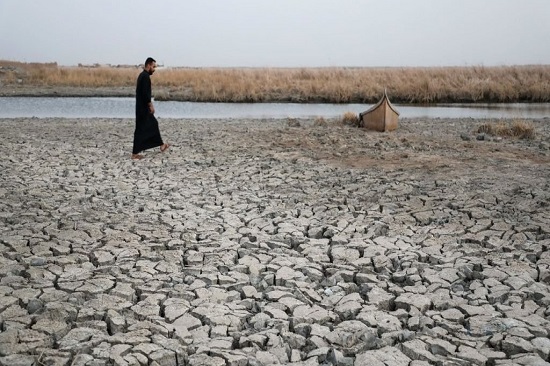
Iraq lies within the desert and semi-desert climate zone, characterized by scarce and irregular rainfall, both temporally and spatially. Rainfall is concentrated in winter, with higher amounts in the northern and northeastern regions, while significantly lower in the central and southern regions. Rainfall also fluctuates considerably from year to year. Global climate change has exacerbated this variability through rising temperatures, increased droughts, shorter rainy seasons, and more frequent extreme weather events. Consequently, reliance on rainfall as a stable water source has declined, negatively impacting agricultural production and food security.
The scarcity of rainfall leads to a marked decrease in agricultural production and stunted crop growth, particularly in rain fed agriculture. It also contributes to soil degradation and increased salinity due to reduced natural salt leaching. Farmers are forced to rely more heavily on irrigation and groundwater, depleting water resources and driving up production costs. The effects of drought extend to livestock through the decline of natural pastures and feed shortages. Furthermore, the scarcity of rainfall accelerates desertification, making adaptation to these challenges essential for the sustainability of the agricultural sector. The electricity sector is the most affected by water scarcity, as it relies heavily on water resources for both power generation and the operation of power plants. With declining rainfall, water levels in reservoirs behind dams such as Mosul, Dokan, and Darbandikhan drop, leading to reduced operational capacity at hydroelectric power plants and shorter daily operating hours. This increases reliance on thermal power plants, which require fossil fuels and incur high operating costs.
The reasons for water scarcity in Iraq include fluctuating and decreasing rainfall due to climate change, policies of upstream countries, dam construction on the Tigris and Euphrates rivers, poor water resource management, high rates of water loss in irrigation networks, and population growth and increasing water demand. To address these challenges and ensure water sustainability, a comprehensive, multi-level strategy must be adopted. This strategy should include rationalizing water use in all sectors, especially agriculture and industry, through the development of modern irrigation networks such as drip and sprinkler irrigation to reduce waste and enhance regional and international cooperation with upstream countries to ensure fair and stable shares of the Tigris and Euphrates rivers. Diversifying water sources is also an essential part of the solution through rainwater harvesting, reuse of treated wastewater, and sustainable exploitation of groundwater resources. Modern technologies should be applied to monitor water consumption and quality, including remote sensing systems and artificial intelligence data analysis to enhance efficient resource management. In addition, community awareness and updated legislation play an important role in establishing a culture of rational water use and protecting ecosystems, which ensures the sustainability of water resources and the achievement of long-term sustainable development.
#Upper_Euphrates_Center_for_Sustainable_Development_Research