| News Details |
News Report | Unprecedented Floods Feed the Euphrates River with Over a Quarter Billion Cubic Meters
2026-03-27
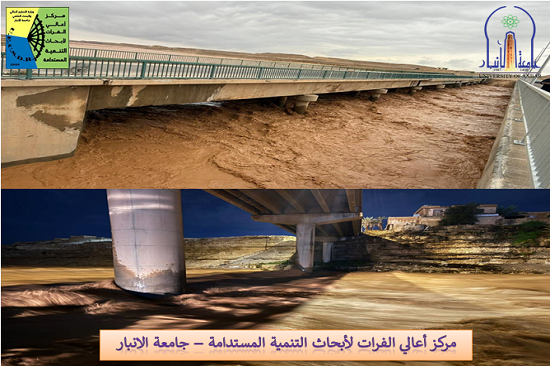
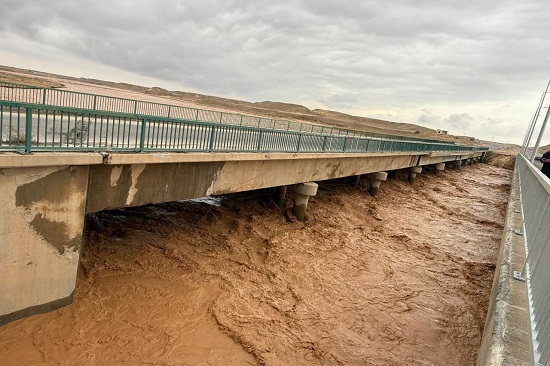
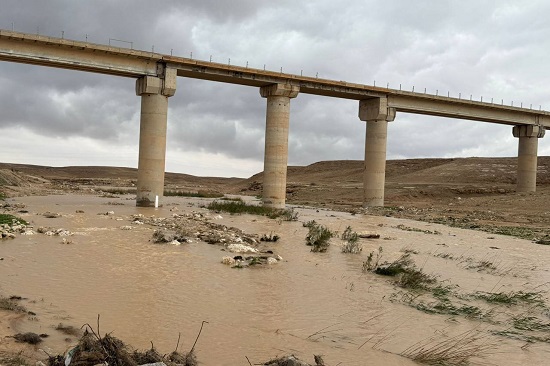
The valleys of the western region of Anbar Governorate witnessed an unprecedented wave of floods due to heavy rains on March 26 and 27, 2026, recording record flow rates, most notably in Valley of Houran, where the flow rate exceeded 3,000 cubic meters per second. This exceptional water phenomenon reflects the intensity of the rainfall and its direct hydrological impacts.
In this context, the staff of the Terminal Station in Haditha, affiliated with the Upper Euphrates Center for Sustainable Development Research at the University of Anbar, continued their monitoring and measurement work for the seventh consecutive day to track the developments of the flood wave and assess its effects on the region's water system.
Engineer Juma’a Muhammad Ahmad, the station manager, explained that monitoring teams recorded a discharge of 175 cubic meters per second in Valley of Hajlan, within the city of Haditha, at 4:30 PM on Thursday, March 26. This followed a peak discharge of 600 cubic meters per second earlier that morning.
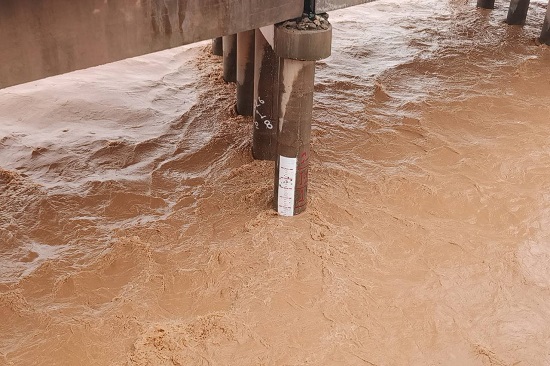
In Valley of Houran, the highest discharge was recorded on Friday morning, March 27, 2026, exceeding 3,000 cubic meters per second. The water level reached the edge of the Houran Bridge near the Ramadi-Haditha road, reflecting the severity of the situation and the volume of water flowing.
In Valley of Zaghdan, the discharge reached 45 cubic meters per second at 10:00 AM on Thursday, before decreasing to 15 cubic meters per second on Friday, March 27. For his part, the center's director, Professor Dr. Ammar Hatem Kamel, confirmed that the significant increase in floodwater runoff is a natural consequence of the continued rainfall, which has saturated the soil and brought it to its maximum infiltration capacity. This, in turn, has reduced water loss and diverted most of the rainwater into surface runoff that feeds the main valleys.
He added that these ideal conditions have contributed to substantial water inflows into the Euphrates River. The amount of water flowing from Valley of Hajlan during the period from March 25 to 27 reached approximately 44,820,000 cubic meters, while Valley of Houran recorded flows of 199,584,400 cubic meters, and Valley of Zaghdan 2,916,000 cubic meters. Thus, the total water inflow from these three valleys alone in just three days exceeded 247,320,400 cubic meters, or more than a quarter of a billion cubic meters.
Based on available data from 2019 to 2026, experts at the center believe that these large quantities of water represent a strategic opportunity that can be leveraged through two main avenues:
First, enhancing water storage in Habbaniyah Lake through Al-Warar regulator, while simultaneously developing the lake's role within the water resources management system, particularly in light of climate change. The center had previously proposed an operational plan involving the release of 5–10 cubic meters per second for a week, depending on the volume of incoming flows.
Second, reviving the regulating dam project in the Al-Baghdadi area, which is expected to play a pivotal role in regulating flows in the Euphrates River and improving the operational efficiency of the Haditha Dam, especially since most of the major valleys flow into the river downstream of the dam, poses a challenge to water management during the rainy season. In this context, the center's director announced the readiness of its experts and researchers to cooperate with relevant authorities, including the Directorate of Water Resources and the Ministry of Water Resources, to re-examine the Al-Baghdadi Dam project, which has a design capacity of approximately 500 million cubic meters. He noted that nearly half of this capacity was actually achieved in just three days from the flows of three valleys, highlighting the project's strategic importance.
To emphasize the significance of this storage capacity, he explained that, according to international standards, a capacity of this size could cover the water needs of a city the size of Ramadi for an entire year, thus reinforcing the importance of utilizing floodwater within sustainable water resource management plans in Iraq.
- To view the floods in Valley of Hajlan on Friday, March 27, 2026... Click here
- To view the floods in Valley of Houran on the morning of Friday, March 27, 2026... Click here
- To view the floods in Valley of Houran on the evening of Friday, March 27, 2026... Click here
#Upper_Euphrates_Center_for_Sustainable_Development_Research