| News Details |
Highest Rainfall Recorded in Ramadi in Over 100 Years
2026-03-29

The Upper Euphrates Center for Sustainable Development Research at University of Anbar announced the highest rainfall recorded in Ramadi in over a century, based on data issued by the Planning and Databases Department in cooperation with the Meteorology Department at the center, as part of a comprehensive analysis of data from its monitoring stations.
The head of the Planning and Databases Department, Assistant Professor Dr. Atheer Salim Obaid, explained that the center's station, located on the University of Anbar campus, recorded a rainfall of 88.2 mm during March 2026. This is the highest recorded value compared to historical data for the same month, which dates back to 1923. The previous highest amount was 48.1 mm, recorded in March 1989, confirming that this year's rainfall is the highest in over 100 years.
In Haditha, the center's research station recorded 78.6 mm of rainfall during March 2026, the second highest recorded amount after the record of 92.8 mm set in March 1974.
In Rutba, the center's measuring station recorded 44.2 mm of rainfall during the same month, which is higher than the average for that month, but not a historical record.
Dr. Haitham Abdul-Muhsin Afen noticed that the weather forecasts issued by the Meteorology Department were largely consistent with the satellite data previously announced by the specialized team under the supervision of satellite meteorology expert, Assistant Professor Dr. Ahmed Jassam Mukhlif. He confirmed that the department is currently developing an early warning system for rainstorms and flash floods via a dedicated mobile application, in collaboration with programming and computer specialists. In the same context, Professor Dr. Ammar Hatem Kamel, the center's director, explained that the significant increase in flood volume this year is due to the frequent and intense rainfall over short periods. The rains between March 19th and 21st raised soil moisture levels to near saturation, thus reducing the soil's subsequent absorption capacity. With further rainfall between March 24th and 27th, a large portion of the water became surface runoff due to the increased surface runoff coefficient, resulting in large and continuous floods.
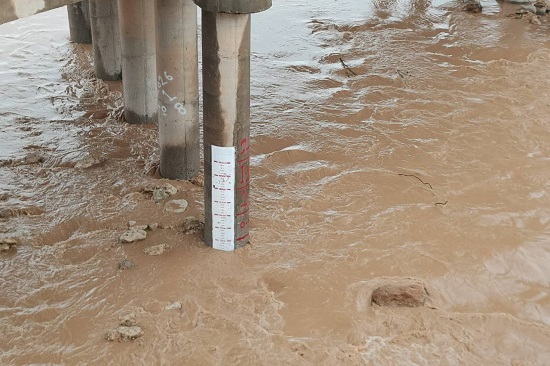
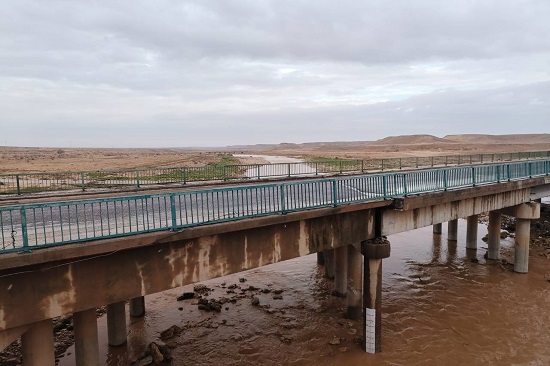
These effects were clearly observed in the Valley of Houran, where the floods continued until March 29th, 2026, with a recorded water discharge of approximately 10 cubic meters per second at 4:00 PM. It is worth mentioning that the Upper Euphrates Center for Sustainable Development Research launched, within the strategic plan of University of Anbar, a specialized program to monitor climate changes in Anbar Governorate, within the framework of enhancing the university’s role in serving the community and achieving the goals of sustainable development in line with Vision 2030.
#Upper_Euphrates_Center_for_Sustainable_Development_Research