| News Details |
Publishing a scientific paper in a reputable international journal
2025-08-20

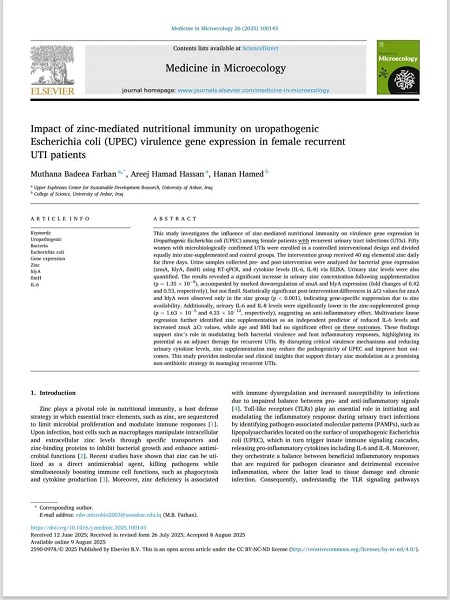
Assistant Professor Dr. Muthanna Badi Farhan, and Assistant Professor Areej Hamad Hassan, researchers at the Euphrates River Center for Sustainable Development Research - University of Anbar, in collaboration with Assistant Lecturer Hanan Hamid, a faculty member from the College of Science - University of Anbar, have published an international scientific research paper in the journal Medicine in Microecology, Volume 26 of the journal, which is classified in the second quartile in Scopus (Q2). The Cite Score for this journal is 4.6, and the research was titled:
"Impact of zinc-mediated nutritional immunity on uropathogenic Escherichia coli (UPEC) virulence gene expression in female recurrent UTI patients"
The aim of the research is to study the impact of zinc-mediated nutritional immunity on the gene expression of virulence factors in Uropathogenic Escherichia coli (UPEC), which is one of the most important bacteria causing recurrent urinary tract infections in women. The study included 50 patients who were divided into two groups. The bacteria isolated from the samples belonged to the species Escherichia coli, specifically the Uropathogenic Escherichia coli (UPEC) group. The gene expression of three main genes of the isolated bacteria was analyzed: znuA (encoding the zinc uptake system), hlyA (encoding hemolysin), and fimH (encoding the adhesion factor) using the RT-qPCR technique. The results showed that zinc led to a significant decrease in the gene expression of znuA and hlyA (0.42 and 0.53, respectively), while the fimH gene was not significantly affected. It was also found that the levels of the inflammatory cytokines IL-6 and IL-8 in the urine decreased significantly after zinc administration, indicating an anti-inflammatory effect.
The study concluded that zinc can reduce the virulence of UPEC bacteria and decrease their ability to cause urinary tract infections in females.
- Link to the research in the journal:
https://doi.org/10.1016/j.medmic.2025.100143
#Upper_Euphrates_Center_for_Sustainable_Development_Research