| News Details |
University of Anbar Achieves New Scientific Achievement in Sustainable Building Materials
2026-02-08
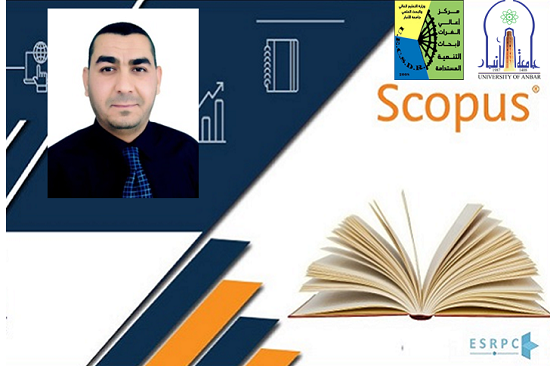
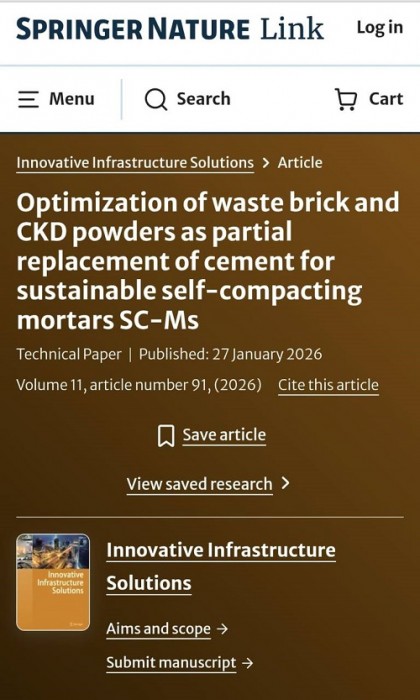
In support of rigorous scientific research and to enhance the university's role in addressing environmental and developmental issues, the Upper Euphrates Center for Sustainable Development Research at University of Anbar announces the publication of a peer-reviewed research paper indexed in Scopus and Clarivate. The paper, authored by Assistant Instructor Saif Sa’ad Mansour, addresses one of the most significant environmental challenges related to the building materials industry. The research is titled:
“Optimization of Waste Brick and CKD Powders as Partial Replacement of Cement for Sustainable Self-Compacting Mortars (SC-Ms).” The research was prepared by a joint team including:
- Eng. Saif Sa’ad Mansour – Upper Euphrates Center for Sustainable Development Research
- Dr. Mahmood Khasha’a – Department of Civil Engineering, College of Engineering
- Eng. Abdulrahman Suhail Mohammed – Department of Dams and Water Resources Engineering – College of Engineering
This research was published in the reputable international scientific journal: (Innovative Infrastructure Solutions), indexed in Scopus – Q2
Clarivate Analytics
CiteScore: 4.4
Impact Factor: 2.4
The study focused on improving the performance of sustainable self-compacting mortar by using brick waste (WB) and cement kiln dust (CKD) as partial replacements for Portland cement. The aim was to reduce environmental impact, lower carbon dioxide emissions, and decrease production costs while maintaining the required engineering properties.
The research results showed that using carefully calculated proportions of these waste materials can achieve an optimal balance between mechanical performance, environmental sustainability, and economic feasibility. This makes this approach a promising solution for restoration and sustainable construction applications, contributing to the principles of the circular economy and the achievement of sustainable development goals. This achievement confirms the active role of University of Anbar in producing applied research with societal and industrial impact, and enhancing its scientific presence in reputable international journals.
#Upper_Euphrates_Center_for_Sustainable_Development_Research