
| News Details |
Sustainable Development Goals: From a Global Vision to a Practical Roadmap to Support Decision-Makers
2026-02-15
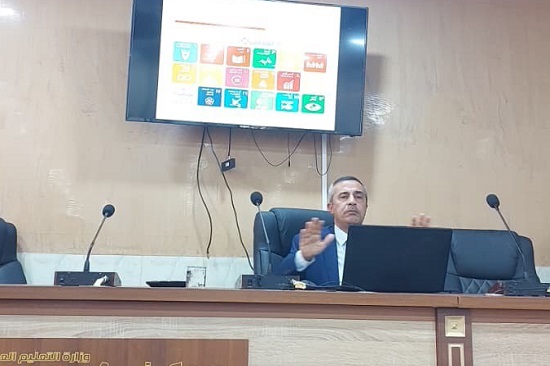
As part of the scientific activities of the Upper Euphrates Center for Sustainable Development Research at University of Anbar, a workshop was held to introduce the Sustainable Development Goals (SDGs), their importance, the necessity of developing our expertise and knowledge of these goals and their feasibility, and the role of researchers and research centers in disseminating a culture of sustainability and its importance in developing societies. The workshop was presented by Professor Dr. Ammar Hatem Kamel, the center's director, and was also prepared by Professor Dr. Isam Mohammed Abdulhameed, a practicing professor in the College of Engineering, and Assistant Professor Dr. Ahmed Saud Mohammed, a researcher at the center. The workshop's main themes included the following:
The Sustainable Development Goals are one of the most prominent global initiatives launched by the United Nations to address the economic, social and environmental challenges facing the world. They were officially adopted in 2015 as part of the 2030 Agenda for Sustainable Development, with the participation of 193 countries, forming a comprehensive framework that includes 17 interconnected goals that seek to eliminate poverty, protect the planet, and ensure prosperity for all.
The formulation of these goals is the result of a long process of international consultations and dialogue among governments, experts, civil society organizations, and the private sector, building on the experience of the Millennium Development Goals (MDGs) which spanned from 2000 to 2015. The new goals are characterized by their comprehensive nature, balancing the three dimensions of development: economic, social, and environmental, while emphasizing the principle of “leaving no one behind.”
Despite the widespread adoption of the concept of sustainable development, experts stress that the real challenge lies not in adopting slogans, but in translating these goals into measurable and implementable policies. This requires building accurate databases, establishing clear performance indicators, enhancing integration among government institutions, and involving the private sector and civil society in the planning and implementation processes.
Development experts also point out that transforming the goals into a practical roadmap involves linking them to national plans and public budgets, adopting scientific analytical tools that support decision-makers in assessing priorities and allocating resources efficiently, and investing in education, technology, and good governance as fundamental pillars for achieving long-term sustainable development. Given the growing challenges facing many countries, particularly in the areas of water, energy, climate change, and food security, the importance of adapting the Sustainable Development Goals (SDGs) to national contexts and transforming them from a global theoretical framework into practical action plans that have a tangible impact on citizens' lives is paramount.
The remaining years until 2030 are crucial for accelerating development efforts, requiring broader partnerships and bolder decisions to ensure a more sustainable and equitable future for generations to come.
It is worth noting that Anbar University has incorporated several pillars into its five-year strategic plan for its 2030 vision, aimed at achieving the SDGs.
#Upper_Euphrates_Center_for_Sustainable_Development_Research






